Showing posts with label literature. Show all posts

Thursday, December 11, 2014

A Portrait of "Ulysses" as a Young Novel

Book Review: The Most Dangerous Book: The Battle for James Joyce's Ulysses by Kevin Birmingham
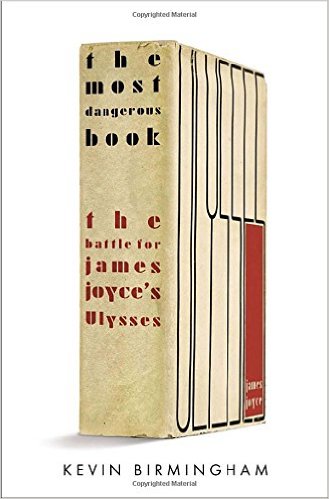
In all of my reading experience (and I am talking about literally thousands of books under my belt), somehow I have managed to miss out on the unique experience that is James Joyce's Ulysses.

Now, having read Kevin Birmingham's The Most Dangerous Book, I still may not have the urge to dive into Joyce's stream of consciousness, but I certainly have an understanding of what makes it one of the most important books of modern (and modernist) literature.

Discussions of literature often treat the work as somehow separate from the context in which it was written, and often as separate from the author himself. Birmingham treats us to more than just a critical analysis of Ulysses, of which scores have already been written. Dangerous Book is equal parts history, biography, and literary criticism; it places James Joyce and his work in the context of contemporary events, the work of other authors, and Joyce's personal struggles. Rather than looking at Ulysses as a thing apart, he takes us between the covers of the often troubled mind of Joyce, and the often troubled times he lived in.

As Birmingham show us, Ulysses becomes more than just the prototypical modernist novel, more than just a controversial and banned book. In no small way, Ulysses is the story of James' own journey as an author; the journey of his crowning work from scattered notes to the printed page is no less an epic voyage.

The interplay of life and art that is revealed here is astounding in its complexity. Ulysses, that most dangerous book, scared censors not just for what it tells about the characters in the story, but for what it tells us about ourselves. Kevin Birmingham draws us a portrait of a man, his book, and the world around them, and shows us how they all fit together to bring Ulysses home.

Saturday, March 23, 2013

What Literature Isn't

Book Review: How Literature Saved My Life by David Shields

Before David Shields makes any declaration about literature's impact on his life, methinks he should first learn what literature is ... and isn't.

How Literature Saved My Life is yet another in a series of recent books that seems to be no more than a series of randomly connected blog posts strung together. In fact Mr. Shields actually states that a blog IS literature - stating that he simply does not have the time to read more. I suppose that explains this disconnected series of 'tweets' about books that he has written, or purportedly read.

According to the dictionary, literature consists of "writings in which expression and form, in connection with ideas of permanent and universal interest, are characteristic or essential features". Assembling sound bites from other authors, no matter what THEIR credentials may be, does not make one an author.

The stream of consciousness method has been utilized to exceptionally better and more telling effect than Mr. Shields manages to produce. If the intent behind How Literature Saved My Life is to exhibit a lack of sophistication in modern readers, it succeeds.

Thursday, October 11, 2012

For Fans of The Three Musketeers

Book Review: The Black Count: Glory, Revolution, Betrayal and the Real Count of Monte Cristo by Tom Reiss

As a student of history, and a fan of the writings of Alexandre Dumas, I had high expectations for The Black Count. I'm happy to report that author Tom Reiss (The Orientalist) did not disappoint.

The latter half of the 18th century was a time of political turmoil, with long-seated governments overthrown, and wide-ranging changes made to the established order. These heroic times bred heroic men; Alex Dumas was just such a man. Physically imposing, a skilled swordsman and horseman, he was the epitome of a man of the age. There was just one problem - although his father was a French aristocrat, his mother was a black slave.

Tom Reiss manages to tie together the real-life character of Alex Dumas and the literary characters of his son's novels, set against the background of the years leading up to and through the French Revolution. Instead of a dry recitation of European history, we are treated to the living and breathing adventures of a truly larger-than-life officer and gentleman. The Count of Monte Cristo and The Three Musketeers may have been fiction, but it is easy the see where Alexandre Dumas took his inspiration - the real life story of his father.