Showing posts with label nonfiction. Show all posts

Friday, April 20, 2018

The Truth About Managers

Book Review: The Truth About Managing People by Stephen P. Robbins

If we are to judge by books about management, what managers truly need is a course in time management. Apparently the average manager does not have the time to read more than a two-page distillation of how to hire the right people or how to discipline an employee. One-minute management techniques yield exactly the results you would expect - a quick and dirty "fix" that isn't going to be able to bear the test of time.

Or is it that managers simply don't have the attention span necessary to absorb more information than that at a time?

The tone of books on management really hasn't changed over the last two decades, and The Truth About Managing People follows tried and true tracks. Not tried and true management methods, but tried and true methods of selling books on management. Short, pithy summaries of common management pitfalls and the "true" way of dealing with them.

I have been managing people for the last three decades, and the first and only truth I have learned for certain is that formulaic methods of dealing with your employees and your organization will yield mediocre results, uninspired employees, and low job satisfaction. But in the right organization it will get you made a vice president.

Friday, December 16, 2016

The Joyride Zone

Book Review: Joyrides Around San Diego by Jack Brandais

"You're traveling through another dimension, a dimension not only of sight and sound but of mind. A journey into a wondrous land whose boundaries are that of imagination. That's the signpost up ahead - your next stop ..." ... The Joyride Zone!

For the majority of people, San Diego can be defined by the "high points": Balboa Park, the San Diego Zoo, the waterfront, the beaches. The farthest afield most people get is the San Diego Zoo Safari Park in the northern part of the county. I'm not just talking about tourists - many San Diego residents probably don't go much beyond the perimeter defined by their home, their work, and their favorite activity, and the network of freeways that connect them.

Author Jack Brandais is a native San Diegan, and he has made it his particular mission to find, and to chronicle, those spaces in between the high points. The counties of Southern California are among the largest in the United States, and San Diego County is no exception; there are lots of places in-between. For those of us who were born and raised there, those places, and the narrow roads that take you there, are an indelible part of San Diego history.

Joyrides Around San Diego is a compilation of Brandais' Kindle driving guides covering San Diego County from the Pacific Ocean to the Borrego desert. Now, I don't have a GPS in my car, and I still use paper maps, but the Kindle version has certain advantages. There are live links to take you to websites with background information, color pictures ... it's interactive.

On the other hand, the new "hard copy" version has all 10 San Diego Joyrides in one convenient package. You can browse it at your leisure and pick out a destination for the day, or plan a weekend getaway. You can leave it in your glove box and it never needs batteries. And if you want to see that background info, the author has put the links on his Joyride Guru website for your convenience.

Either way, you get driving directions, handy maps, a list of sights to see, and a bit of history to boot. If you're new to San Diego and really want to see San Diego County, this is the place to start. If you're an old-timer like me, this is a great opportunity for a trip down memory lane, literally. Batteries not included - or needed!

Monday, November 14, 2016

Welcome to America

Book Review: Never Look an American in the Eye by Okey Ndibe

What happens when a person's perceptions of the United States are determined by watching vintage American Western movies? The result is Never Look an American in the Eye, Okey Ndibe's multi-faceted tale of his immigration to the U.S. in 1988. Ranging from the humorous to the sharply serious, Ndibe uses a series of anecdotes to explain how and why he chose to leave his native Nigeria, and what happened on his arrival here.

American culture is disseminated to the world in often enigmatic ways. Often it is through media, particularly television and movies. Needless to say this can give viewers on the other side of the world a very different idea on what the "real" America is like. The result can be a shocking wake-up call to the newly arrived potential citizen.

Ndibe does an excellent job of conveying this inevitable culture shock, and the emotional effect it can have on the hopeful immigrant. Between his stories of feeling lost in the swirling tide of new sights and experiences, he also injects bits of humor: the similarity between the pronunciation of his first name, Okey, and the common English exclamation "okay" leads to some exchanges worthy of Abbott and Costello. Examples of American misconceptions about Africa and Africans also serve to lighten the mood while illustrating our cultural indifference.

Amd the mood can be exceedingly dark as well. His tale of being the victim of racial profiling by the police, hampered by his less than perfect grasp of the American justice system (he thought he was being questioned for looking the policeman in the eye) echoes an uncomfortable reality for many Americans, not just the most recent arrivals.

Throughout this portrayal, Ndibe reinforces the certainty that underneath the cosmetic differences, we are all people just trying to make our way. Towards the end of the book, where he relates the death of his father and his return to Nigeria for the funeral, we see a fellow human being, dealing with the pain and emotion that cuts across racial and ethnic lines.

Never Look an American in the Eye points out our preconceptions about immigrants and immigration without beating us up with them, but refuses to ignore them. The United States is an immigrant country, yet we sometimes turn a blind eye to that fact. Okey Ndibe reminds us that there are still people around the world who dream of a better life in the United States, just as our forefathers did, and that they have much they can contribute to our country and our culture.

Tuesday, September 6, 2016

How About Some Pie?

Book Review: Jaunt to Julian by Jack Brandais (Kindle Book)

Like "Joyride Guru" Jack Brandais, I too am a second-generation San Diegan, and spent many a weekend with my mother and brothers on the road to Julian (or points east). I was anxious to see if the trip has changed much over the years, or if it still matched up with the memories of more than four decades ago.

I was glad to see that, other than a few more buildings, the route has retained a good deal of its original character. You can still catch glimpses of San Diego County as it used to be. I was glad to see that Dudley's Bakery was still in business; it was a favorite stop, especially if I could talk my mom into getting me a donut. Their bread is the best!

In addition to the sights along the highway, the author includes some of the back-country routes that my family "discovered" over the years: the Old Julian Highway, Wynola Road, and Farmer Road. You can while away an autumn afternoon just wandering the side roads - it's especially enjoyable when the leaves are turning and the air is crisp as a Julian apple. Just mind your manners and be sure the road you're on isn't somebody's driveway.

And of course, save some room for pie. I like mine warm, with a scoop of vanilla.

I'm old-school, and to me a map is an intricately folded sheet of paper, but Jaunt to Julian covers everything you need to know for either a day trip or a weekend getaway. Hyperlinks provide specific information on sights and side-trips (for casual hikers I recommend the Santa Ysabel Preserve), and there are interesting notes on the history of the town and surrounding areas.
One of a series of Kindle drive guides by the San Diego Union-Tribune's "Weekend Driver" columnist, the late Jack Brandais.

Thursday, December 11, 2014

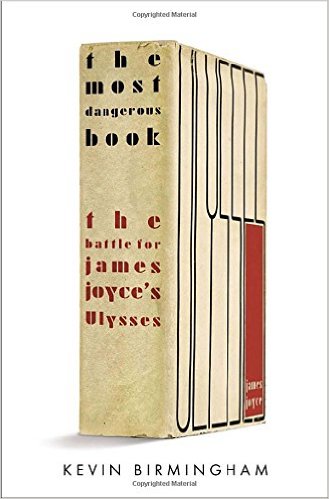
A Portrait of "Ulysses" as a Young Novel

Book Review: The Most Dangerous Book: The Battle for James Joyce's Ulysses by Kevin Birmingham

In all of my reading experience (and I am talking about literally thousands of books under my belt), somehow I have managed to miss out on the unique experience that is James Joyce's Ulysses.

Now, having read Kevin Birmingham's The Most Dangerous Book, I still may not have the urge to dive into Joyce's stream of consciousness, but I certainly have an understanding of what makes it one of the most important books of modern (and modernist) literature.

Discussions of literature often treat the work as somehow separate from the context in which it was written, and often as separate from the author himself. Birmingham treats us to more than just a critical analysis of Ulysses, of which scores have already been written. Dangerous Book is equal parts history, biography, and literary criticism; it places James Joyce and his work in the context of contemporary events, the work of other authors, and Joyce's personal struggles. Rather than looking at Ulysses as a thing apart, he takes us between the covers of the often troubled mind of Joyce, and the often troubled times he lived in.

As Birmingham show us, Ulysses becomes more than just the prototypical modernist novel, more than just a controversial and banned book. In no small way, Ulysses is the story of James' own journey as an author; the journey of his crowning work from scattered notes to the printed page is no less an epic voyage.

The interplay of life and art that is revealed here is astounding in its complexity. Ulysses, that most dangerous book, scared censors not just for what it tells about the characters in the story, but for what it tells us about ourselves. Kevin Birmingham draws us a portrait of a man, his book, and the world around them, and shows us how they all fit together to bring Ulysses home.

Wednesday, July 2, 2014

A Man and His Owl and a Reader's Dilemma

Book Review: The Owl Who Liked Sitting on Caesar: Living with a Tawny Owl by Martin Windrow

In general, I do not approve of people keeping wild animals or "exotics", as pets. Quite frankly I don't care much for zoos or aquariums either, especially where the emphasis is entertainment rather than education (for example, Sea World).

The process of taming or containing our wild co-inhabitants often results in their physical and mental degradation and early death. To me, an integral part of the beauty of wild things is seeing them IN the wild.

Martin Windrow decided he wanted a tawny owl as a pet. And while I objected to the reasoning behind his decision, I found The Owl Who Liked Sitting on Caesar to be a thoroughly entertaining story that is educational as well.

So much for preconceptions.

Interwoven with the stories of the trials of having an owl in your apartment (not for the faint-hearted!) there are lessons in the biology and behavior of owls in general, and of tawny owls in particular. Windrow obviously approaches his owl adoption seriously, although not always realistically. As with any pet, there are always unforeseen issues - but the scope of those issues is dramatically different when we're talking about a raptor as opposed to a tabby cat. But owl and man seem to come to a mutually agreeable compromise.

And there is no doubt that Windrow cares deeply about his feathered friend. Depending on how much emotion you want to ascribe to an animal, Mumbles the owl regards Windrow as a central figure in her life as well. That mutual regard and respect is key in our desire for relationships with others, regardless of the species.

Despite my reluctance, I was drawn into the story of The Owl Who Liked Sitting on Caesar; it is filled with humor and humanity that appeals to the naturalist inside all of us. At times I felt there was a certain tunnel vision, a sort of denial on the part of Windrow that caging an owl was not exactly the humane thing to do, regardless of its birth. But aside from my personal objections, it is a captivating and enlightening story that is well worth the read.

Wednesday, February 12, 2014

Nature as it Really Is

Book Review: Sightlines: A Conversation with the Natural World by Kathleen Jamie

"American conservation is ... still concerned for the most part with show pieces ...we have not yet learned to think in terms of small cogs and wheels." - Aldo Leopold

There is more to the natural world than picture-perfect scenic vistas, or majestic animals moving in choreographed precision. Not all wilderness is scenic, not all wildlife is majestic. The small cogs and wheels that keep the eco-system moving are often hard to see unless you know what you are looking for; and once you do, they are just as often not pretty to look at. Yet without them there would be no scenic vistas, or wild animals, or human beings to see and appreciate them.

In Sightlines, Kathleen Jamie shares with us both sides of the natural world, the beautiful and the not-so-pretty: "It's not all primroses and otters ... There are other species, not dolphins arching clear from the water, but the bacteria that can pull the rug from under us." At one moment we are watching killer whales swimming free, in another viewing thin sections of necrotic tissue. Is it so much of a jump to see these are but two sides of the same coin?

In her effort to make sense of what she sees and experiences, Jamie finds the same truth that Leopold found decades before: that the small cogs and wheels are every bit as important as any other part of the eco-system. A stagnant tidal backwater may not be as aesthetically pleasing as a soaring evergreen forest, but its function is every bit as important. The chain of life extends from predators to prey to scavengers; down to the bacteria that complete the process of decomposition each link depends on the others.

The sooner we see that they are all part and parcel of Nature "taking its course", the sooner we come to realize "... you just might be making the same journeys as these other creatures, all of us alive at the same time on the same planet."

Saturday, January 18, 2014

(Re)-Inventing Yourself

Book Review: The Answer to the Riddle is Me: A Memoir of Amnesia by David MacLean

What would you do if you suddenly found yourself in a foreign country, with no recollection of how you got there, or even who you were? I, for one, have never had to answer that question. David MacLean not only had to face that question, but went on to tell about it in his fine work, The Answer to the Riddle is Me.

His subtitle, A Memoir of Amnesia (isn't that an oxymoron?) gives a clue to his often tongue-in-cheek humor in confronting the conundrum of 'who is David MacLean?' For most of us it would be impossible to find anything amusing in losing our identity. MacLean relates the random thoughts that rebounded through his head, and manages to keep a human face on an inhuman experience.

Under that veneer of irreverent bravado, there is sheer terror. Like a drowning man, MacLean finds himself grasping at straws in an effort to stay afloat in his hallucinatory hell. He desperately grabs on to anything and anyone that might give him a clue as to who he was/is. In some cases he finds himself caught between his two selves - the David MacLean he was, a portrait held by family and friends; and the David MacLean he is, who finds that "continuing on in the world of the sane is harder than you thought."

"My hallucinations left me feeling like the inside of my soul had been flapped out for the world to see; the shame I'd carried through my life had bubbled out and been exposed to the air, and now it wouldn't recede." Epiphany is not always a joyful, uplifting experience; sometimes it can be downright painful, even depressing.

The Answer to the Riddle is an intense, deeply personal ride through the inner workings of a mind that has had the "reset" button pushed, and the effort of moving forward from that experience. Sometimes funny, sometimes harrowing, always human, this is one of the most honest books I have ever read.

Thursday, September 26, 2013

In a Word: Exceptional

Book Review: I Can't Complain by Elinor Lipman

When reading a book, I usually find myself coming back to what I call the "Three Cs" - Clarity (how well it is written), Consistency (do the characters behave in character), and Cohesiveness (does the whole thing stick together). I have found over a lifetime of reading (and I am past the half-century mark, thank you) that these measures pretty much apply to any book, in any genre.

Elinor Lipman's I Can't Complain hits all three and throws a few bonuses as well. Of course, since these are personal essays, the main character stays in character - it's Elinor after all. Her writing is concise [an undocumented C], clear, and simply a joy to read. And the whole thing sticks together like Silly Putty.

More than that, Elinor Lipman takes the everyday and makes it ... more than that. Events do not need to be extraordinary to make them meaningful. I think the present generation has lost sight of the simple fact that the simple things and the basic emotions that go with them are important in their own right. Everything does not have to be an adrenaline pumping heart-pounding YouTube event to be important in a person's life. To expect otherwise is, I believe, missing the point of life entirely.

Thank you, Ms. Lipman, for writing about what it is really like to live life, and to be aware you are living it.

Thursday, July 4, 2013

Smuggler Nation: How the Bad Boy Made Good

Book Review: Smuggler Nation by Peter Andreas

"America is a smuggler nation", posits Peter Andreas. As a nation we seem to take a perverse pride in our checkered past, starting with flipping the British Empire the proverbial bird by dumping a load of tea into Boston Harbor (yes, I over-simplify). No other country struts the failings and foibles of our Founding Fathers as much as the good 'ol USA. Personally, I think that is a good thing to some degree.

In Smuggler Nation, Peter Andreas gives us a guided tour through the history of the underground economy in the United States, peeking into historical closets that many Americans may not have been aware of. As a book about American history, Smuggler Nation excels. Where it falls, in my opinion, is in establishing the extent that smuggling has helped fuel our "evolution to a pre-eminent superpower".

The exchange of goods and services, whether on the black market or the open market, is exactly that: an exchange. Our imports of Canadian booze, or French condoms, or Mexican workers have been offset by direct payments and indirect costs of one sort or another; in the long run it is a zero-sum game.

At the same time, the exporters of these goods profited (often illegally on their own side) from the artificially high prices commanded by the contraband nature of their product. Why have these countries not been advantaged in the same way -- are we just better black-marketeers?

I don't think so. I believe America has succeeded due to our unique geographical location, our vast human and natural resources, occasionally exceptional leadership, and a fair amount of luck. While it is ironic that the world's pre-eminent nation of smugglers now seeks to stem the tide of the underground economy, smuggling has been a side effect of our success, not it's driving force.

Tuesday, April 30, 2013

Art is in the Eye of the Beholder

Book Review: Forged: Why Fakes are the Great Art of Our Age by Jonathon Keats

Jonathon Keats' Forged explores the boundaries of what we commonly define as Art, and in the process forces us to question that definition. What appears to be very straightforward on the surface becomes more complicated when obscured by layers of paint.

When is a copy just a copy, and when is it a forgery? Or even more, when is a copy (a la Andy Warhol), art in itself? Many artists began by copying the work of others. And if you are going to copy someone else, wouldn't you copy from the best? Where do we draw the line? Are all copies, however innocent, mere forgeries?

While it may seem that we are merely begging a question of terminology, it goes much deeper than that. As you begin digging into the works of any particular artist, there inevitably are those that even the experts will mark as "attributed to". Not all artists signed all their work; very few actually cataloged it. Art experts often have to rely on questionable provenance and comparisons to known works in order to attribute a work to a particular artist, and it is not unknown to have a work historically ascribed to one artist be later changed to be the product of another.

If you begin researching the recent "renovation" of Da Vinci's "The Last Supper", you will find out that the painting was in fact restored using copies of Da Vinci's master work that had been painted by his assistants. Centuries of misguided and poorly done preservation and restoration had left very little of Da Vinci's work intact. The restored painting that we now see is little more than a copy of a copy, or shall we say, a forgery? Or is that merely in the eye of the beholder?

These are the types of questions that Jonathon Keats makes us consider. The answers are left for us to decide.

Thursday, October 11, 2012

For Fans of The Three Musketeers

Book Review: The Black Count: Glory, Revolution, Betrayal and the Real Count of Monte Cristo by Tom Reiss

As a student of history, and a fan of the writings of Alexandre Dumas, I had high expectations for The Black Count. I'm happy to report that author Tom Reiss (The Orientalist) did not disappoint.

The latter half of the 18th century was a time of political turmoil, with long-seated governments overthrown, and wide-ranging changes made to the established order. These heroic times bred heroic men; Alex Dumas was just such a man. Physically imposing, a skilled swordsman and horseman, he was the epitome of a man of the age. There was just one problem - although his father was a French aristocrat, his mother was a black slave.

Tom Reiss manages to tie together the real-life character of Alex Dumas and the literary characters of his son's novels, set against the background of the years leading up to and through the French Revolution. Instead of a dry recitation of European history, we are treated to the living and breathing adventures of a truly larger-than-life officer and gentleman. The Count of Monte Cristo and The Three Musketeers may have been fiction, but it is easy the see where Alexandre Dumas took his inspiration - the real life story of his father.

Wednesday, August 15, 2012

The World's Toughest Job

Book Review: Father's Day: A Journey into the Mind and Heart of My Extraordinary Son by Buzz Bissinger

As my own children merge into the adult world, I have become increasingly certain that the hardest thing in the world is being a parent - that is, being a "good" parent. Knowing when to guide, when to discipline, when to hold them, when to let go; it's enough to give anyone nightmares.

In Father's Day, Buzz Bissinger adds yet a new element to the waking dream that is parenthood - that of being a parent to a 'special' child. Multiply all of the uncertainty factors by 2, add a 'normal' twin brother, and you have a landscape that Bosch would envy.

While I did not agree with the author on some counts (like taking this trip in the first place!) I could certainly empathize with his situation. Taking a cross-country trip with my two kids by automobile was stressful enough; the bonding experience was excruciating at times. But being a parent means taking the bad with the good. Bissinger wanted to be closer to his son, to get to know him again as he grew into an uncertain manhood.

Father's Day captures the anxiety, turmoil, hope, and love that define what it is to be a parent. At times an enjoyable father-son travelogue, sometimes a painful experience in estrangement, it is as real as it gets in a rented minivan in the heartland of America.

Saturday, July 14, 2012

The Consequences of Denial

Book Review: Full Body Burden: Growing Up in the Nuclear Shadow of Rocky Flats by Kristen Iverson

Author Kristen Iverson seems to be telling us two vastly different stories in Full Body Burden. The first is her own story of growing up in Arvada, Colorado - normal stuff about family and friends and pets and school.

The second story is the tale of the Rocky Flats Plant: its secretive workings, its impact on the environment and the citizens of the Denver Metro area, and the investigations into one of the most radioactively contaminated places on this planet. What brings these two seemingly disparate tales together?

The common thread is the ultimate cost of continual denial. The author refers repeatedly to the closed conversations within her family. There were some things you just didn't talk about; whether they were true or not was irrelevant. Her father's alcoholism symbolizes her family's emotional distance from reality. The gradual slide becomes a slippery slope and half-truths become untruths. As her parents' marriage goes into meltdown they desperately try to fill the cracks in the facade and refuse to deal with the problems around them.

The federal agencies charged with regulating Rocky Flats tried first to deny there was an issue at all; defining 'healthy' limits of radioactive exposure when there was no research to base those numbers on. As the leakage of radioactivity and information continued, the DOE tried to do a patch job, throwing the stone wall of "National Security" around the crumbling infrastructure, facts be damned.

Even today, the truth regarding Rocky Flats (now a National Wildlife Refuge) is not fully known: "The final contamination levels of Rocky Flats itself as measured by the U.S. government after the Superfund cleanup, and those reported to an impanelled grand jury, are sealed records and have not been reported to the public." [Wikipedia] The denial continues.

While Ms. Iverson does an excellent job pulling the threads of her twin stories together, there were a few points in the narrative where I felt a little confused about the timeline of events, and a little lost in the turmoil of her family. I imagine she felt the same. A solid four stars with those qualifications, and a huge "Thank you" to the author for bringing us this work.
(Note: This reviewer lived and worked in the Denver Metro area for twenty years.)

Thursday, October 6, 2011

What Dogs Really Want

Book Review: In a Dog's Heart: What Our Dogs Need, Want, and Deserve--and the Gifts We Can Expect in Return by Jennifer Arnold

There are at least as many books on raising dogs as there are on raising children, and undoubtedly as many points of view. There are scores of television shows and Internet sites professing to have the "secret" of success in teaching Fido what to do, and more importantly, what NOT to do.
So what makes In A Dog's Heart any different?

What makes companion animal trainer and dog rescuer Jennifer Arnold the voice we should listen to? She starts with one simple premise: treat "man's best friend" like a friend. Dogs have evolved and grown alongside mankind for thousands of years. Their wants and needs are parallel to our own - to be physically well, to be safe, to know friendship and love, and to be content in their lives. And as dogs help us find these things for ourselves, as friends we should help them do the same.

Arnold points out that much is made in current dog training of the "pack mentality" of the dog's wolf ancestors. The theory is that our dogs must be taught their place, with we their owners as the "alpha" canines. Arnold shows (and research supports) that dogs are not wolves, and even if they were, a pack is not a group of individual animals fighting for dominance. A pack is a family unit; the alpha pair are the parents, and the pack works together to supply its needs. Think about it - a group of animals continually fighting each other for dominance would not last as a unit for long in the wild. And they won't last long in the home either.

Arnold gives us helpful pointers for understanding our dog's behaviors from the dog's perspective. He just wants to be well, and safe, and loved, and happy. He simply lacks the vocal ability to tell us how that can happen. He acts out his worries and fears (like many of us humans do as well). We need to learn to read the signs, not browbeat our friends into silence.

And no that doesn't mean we let our dogs run wild. Arnold also teaches how to deal with problem behaviors, from chewing furniture to jumping up to biting. Dogs have spent millennium learning to get along with us; we need to spend a few hours returning the favor.

As a lifetime dog owner (we have three FOUR right now) I found In a Dog's Heart to be a humane, insightful, and knowledgeable approach to selecting, raising, and enjoying a healthy loving dog.

Tuesday, July 5, 2011

What Really Matters

Book Review: Teach Us to Sit Still: A Skeptic's Search for Health and Healing by Tim Parks

What happens when a person grounded in rationality and whose faith lies in science and technology, finds themselves face-to-face with a problem beyond the reach of modern medicine? Tim Parks, a man who found it impossible to sit still, finds himself on a journey to a place he could not conceive or believe in his quest for answers. In Teach Us To Sit Still, he gives us a glimpse of that journey.

Tim Parks was in pain -- an insistent, intractable, undeniable pain. He went to doctor after doctor, underwent test after test. The professional opinion was that there was nothing really wrong with him; that is, nothing that would explain the pain. Procedures were suggested, not with any promise of relief but for lack of better options.

His experiences with medical professionals in different countries (England and Italy) echo my own in this country. The patient should do what he is told, the experts know best, and his friend the surgeon will wait until he comes to his senses. "There is part of me," he says in describing one procedure, "at these moments, eager to rebel. Yet I never do. I imagine it is the same at executions."

But slowly, reluctantly, he does rebel. Averse to anything he would call faith-healing, he dips his toes into various streams of alternative medicine, always keeping one foot firmly on the ground of logic. Even with his doubts and distrust of anything remotely mystical, the pain starts to recede. It is not any one thing that brings him back to well-being, no more than it was any one thing that made him ill to begin with.

Tim Parks is not proselytizing for any cure. This is not The Idiot's Guide to Prostrate Pain; it is not a self-help book with a checklist of do's and don'ts. Teach Us To Sit Still is the story of Tim Parks' "process of self-purification by self-observation." It is a help-full book, a tale of one man's re-discovery that the devil IS in the details - in the seemingly inconsequential matters that make up our daily lives. In our headlong rush to the next big thing we are missing the point of the journey. Tim Parks is sharing his.