Saturday, March 23, 2013

What Literature Isn't

Book Review: How Literature Saved My Life by David Shields

Before David Shields makes any declaration about literature's impact on his life, methinks he should first learn what literature is ... and isn't.

How Literature Saved My Life is yet another in a series of recent books that seems to be no more than a series of randomly connected blog posts strung together. In fact Mr. Shields actually states that a blog IS literature - stating that he simply does not have the time to read more. I suppose that explains this disconnected series of 'tweets' about books that he has written, or purportedly read.

According to the dictionary, literature consists of "writings in which expression and form, in connection with ideas of permanent and universal interest, are characteristic or essential features". Assembling sound bites from other authors, no matter what THEIR credentials may be, does not make one an author.

The stream of consciousness method has been utilized to exceptionally better and more telling effect than Mr. Shields manages to produce. If the intent behind How Literature Saved My Life is to exhibit a lack of sophistication in modern readers, it succeeds.

Tuesday, February 5, 2013

The Craftwork of H.P. Lovecraft

Book Review: H.P. Lovecraft: The Complete Fiction by H. P. Lovecraft, edited by S. T. Joshi

I received H.P. Lovecraft: The Complete Fiction as a gift from my son; it is truly one of those gifts that keeps on giving.

My previous exposure to Lovecraft was limited to a short story here or there in a horror anthology, so obviously I am not a hardcore Lovecraft (or horror fiction) aficianado. Whether or not this is truly the 'complete' fiction of Lovecraft (this seems to be a matter of disagreement by fans) I am likewise in no position to judge. However there are some truly stellar aspects of this collection that I would like to share.

The brief introduction at the beginning of each piece by editor S.T. Joshi was a nice addition. Generally a short paragraph giving a bit of background on the piece, it helps place the work in the continuum of Lovecraft's writing career. I did not feel that they contained any major 'spoilers', but rather discussions of stylistic forms, date of first publication, and notes of interest such as rejection by a certain publisher. As a novice Lovecraft reader I found them helpful.

The book takes you more or less chronologically through Lovecraft's work, rather than grouping the stories by style or subject. I enjoyed being able to see how the author evolved over the course of his apprenticeship into the craftsman he was to become. You can see how other authors influenced him, and how he truly learned by doing, integrating ideas from his previous works into what became the Cthulu mythos.

This is a heavy book, in subject as well as mass, so it's not one to read nonstop in the course of a few days. This has held the place of honor on my nightstand for months, to be tasted in discreet and enjoyable morsels, mulled over and digested, then tasted again. It has certainly brought some interesting color to my dreams.

Friday, January 25, 2013

Twisting Reality like Taffy

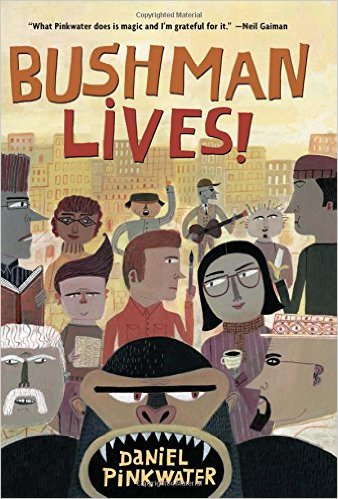
Book Review: Bushman Lives! by Daniel Pinkwater

Bushman Lives was my first exposure to the work of author Daniel Pinkwater, and overall it was an enjoyable experience. I was reminded of the work of Louis Sachar (Holes, the Wayside School series), not an unflattering comparison, with that same 'dropped down the rabbit hole' feeling to it.

What happens is that the author introduces us to a fairly normal character in a fairly normal situation - and then begins to pull and stretch it in different un-normal ways. Reality takes on the consistency of Silly Putty; malleable, elastic, and taking the imprint of things which it is pressed against. The result can be both amusing and enlightening, although requiring suspension of disbelief to increasing depths. When is a house not a house? When it's covered in whitewash of course!

However much I enjoy this sort of thing, Bushman Lives didn't quite fulfill my expectations. It feels incomplete-there were infinite possibilities, but I felt like I had been left hanging. I was not expecting a 'happily ever after' conclusion, but neither was I looking for the book to just sort of trail off ...

Saturday, December 15, 2012

An Average Story of an Average Life

Book Review: Fool by Frederick Dillen

Mind you, there is nothing wrong with average - it is of course that part of the bell curve under which most of us live. I am not one that believes that extraordinary writing must only refer to extraordinary characters; if that was true there would be few books worth reading indeed.Writers like John Steinbeck and Sinclair Lewis made their mark writing amazing fiction about the less than amazing lives of nobodies not unlike you or me.

Sadly, Frederick G. Dillen's Fool fails to bring any resonance to the story of anti-hero Barnaby Griswold. The story doesn't reverbrate or reflect or amplify - which even a story about average people (for instance Lewis' Main Street or Steinbeck's The Wayward Bus) is capable of doing. It drifts along much as its protagonist does: directionless, incomplete, and unfulfilled.

Barnaby is not unlikable, although at times he doesn't much like himself; some of his fellow characters actually care about Barnaby. His actions, his goals, and his beliefs are not any different than many people you would meet in real life, or in really good fiction. The characters are believable, the plot sustainable - yet Fool doesn't quite bring it off.

Barnaby may consider himself a fluffmeister, of which there are plenty in this world, but he is not devoid of life. I did not expect Barnaby to come to any heroic revelations or noble enlightenment. However, his story comes across as no more substantial than a wallpaper tiger, leaving Barnaby no more than a cutout himself, and Fool only a moderately entertaining bit of fluff.

Monday, November 12, 2012

The American Way

Book Review: Visiting Tom: A Man, A Highway, and the Road to Roughneck Grace by Michael Perry

Once upon a time - 'back in the day' - knowledge was handed down from generation to generation, self-reliance and thrift were considered virtues, and being a good neighbor was not an advertising slogan. In Visiting Tom, Michael Perry shows us that 'once upon a time' is the present, at least in the person of Tom Hartwig.

While we sit and decry the decline in American innovation, Tom was building his own sawmill. While we bemoan the increasing encroachment of government, Tom was persuading the highway department to reroute the interstate that bisects his property. While we worry about going green, Tom is repairing, reusing, and recycling, renewing the old and creating anew.

This is not a Luddite dream of returning to the past, throwing technology aside. It's about embracing the knowledge of the past and applying it to the present and future, of recognizing home-grown initiative and perseverance and moving them to their rightful places in the arsenal of American ideas.

While these may be regarded as old-fashioned, small Midwest town values, we could all do worse than to sit a spell with Tom and absorb some of the knowledge and expertise that were once an integral part of American culture. Visiting Tom gives us that opportunity.

Thursday, October 11, 2012

For Fans of The Three Musketeers

Book Review: The Black Count: Glory, Revolution, Betrayal and the Real Count of Monte Cristo by Tom Reiss

As a student of history, and a fan of the writings of Alexandre Dumas, I had high expectations for The Black Count. I'm happy to report that author Tom Reiss (The Orientalist) did not disappoint.

The latter half of the 18th century was a time of political turmoil, with long-seated governments overthrown, and wide-ranging changes made to the established order. These heroic times bred heroic men; Alex Dumas was just such a man. Physically imposing, a skilled swordsman and horseman, he was the epitome of a man of the age. There was just one problem - although his father was a French aristocrat, his mother was a black slave.

Tom Reiss manages to tie together the real-life character of Alex Dumas and the literary characters of his son's novels, set against the background of the years leading up to and through the French Revolution. Instead of a dry recitation of European history, we are treated to the living and breathing adventures of a truly larger-than-life officer and gentleman. The Count of Monte Cristo and The Three Musketeers may have been fiction, but it is easy the see where Alexandre Dumas took his inspiration - the real life story of his father.

Monday, September 3, 2012

The Surreal Experience Known as "Being Alive"

Book Review: Juliet in August by Dianne Warren

For this reader, what sets a few novels above the majority lies in a rather subjective quality: does the author make me feel the characters, rather than just see them? In a great movie this is that moment when you realize that you weren't just watching the movie, you were in it.

That moment occurred as I was reading Diane Warren's Juliet in August at about the third page. I may be wrong; it might have been closer to the fifth page. That feeling lasted until the end of the book, over the several days I was reading it.

Now I can read as fast as anyone, and I have had those "stayed-up-all-night-reading" events as well. While visiting Juliet (which is a place, not a person), I found myself reading more slowly than usual, sipping a cuppa, taking my time and getting the feel of the country.

There is a flow to living in a small town, and it's not everyone's cup of tea. Life moves slower than in the city, but it's there all the same. Faster is not always better -- you miss a lot hurtling down the freeway. The best way to see the world around you is ... on a horse. Preferably a horse that you just found and use to re-enact a legendary 100-mile horse race.

OK, so that's not part of the normal flow of a small town, but it is around this somewhat improbable thread that Warren wraps the stories that make up Juliet. Before long a man on a horse seems no more out-of-place than any of the 'ordinary' events taking place: the day-to-day ebb and flow of life, love, and relationships. Simple small town life? Sure!

Pull up a chair, and dive in to Juliet. I'll make you a cup of tea.