Monday, August 15, 2016

How History is Written

Book Review: The Last Communard by Gavin Bowd

Although I am a fan of history, I must admit that I was not that familiar with the history of the Commune, and had no idea who Adrien Lejeune was.That was part of the reason I ordered this book.

What I got was less of an education in the Commune and the last Communard than a lesson in how history is written. Lejeune, who was at best a bit player in the Commune, was made into a symbol of the Communist Party through the succeeding years. Through the machinations and propaganda of various arms of the Party, he became larger than life. While he whiled away the hours in various institutions in the Soviet Union, intent on maintaining his supply of wine and chocolate, Party factions played upon his notoriety, intent on their own agendas as well.

Sometimes the litany of unfamiliar and foreign names and locations become tedious and dry; this reader often felt like he was climbing an enormous shifting sand dune of facts, with no goal in sight. Author Gavin Bowd does manage to pull things together in the end, and brings sense to what is an interesting overview of a small piece of history and how it fits into the context of the larger picture.

Monday, July 25, 2016

Of Love and War and Immigration

Book Review: Their Promised Land by Ian Buruma

Immigration is a hot button topic right now, liable to induce polarized opinions in just about any audience. Their Promised Land steers a middle course, generally avoiding the shores of politics and the shoals and rocks that surround them, favoring the depths of the subtitle My Grandparents in Love and War

But the immigrant status of the family is always there, a bulking shadow just over the horizon, barely hidden in the fog of two world wars and the unsettled years between them. Ethnic families tried to avoid the latent prejudice by Anglicizing their last names. Jews adopted Christianity in an attempt to avoid the 'stigma' of being different. Author Ian Buruma doesn't ignore the elephant in the room, but in his occasional sidelong glances in its direction he makes it impossible to ignore.

That is a good thing. Immigration has ALWAYS been a hot button topic, laden with unacknowledged racism and prejudice. Each successive wave of immigrants in the United States has faced a backlash from those who have arrived before them; seemingly oblivious to the fact that unless you are 100% Native American, we are all immigrants here. Their Promised Land takes place in England in the first half of the twentieth century, but it could just as well be anywhere, at any time.

Despite this, Buruma keeps us focused on the fact that these are just two people, trying to make a life for themselves and raise a family. The universal principle at work here is not that prejudice is always with us, but that people go on in spite of it. That is where our hope lies.

Monday, June 20, 2016

Dogs Will be Dogs

Book Review: Dancing Dogs by Jon Katz

"It is well to bear in mind that the truth about dogs is as elusive as the truth about man. You cannot put your finger on any quality and safely say, 'This is doglike,' nor on any other quality and say, 'This is not.' Dogs are individualists." - James Thurber

What made James Thurber the quintessential writer of dog stories is that his dog tales are as individual as the tail on a dog. Although all are written in the inimitable Thurber style, the resemblance ends there. From Muggs to Rex, Medve to Jeannie, the stories of Thurber's Dogs are as unique as the dogs themselves. Thurber's dogs are allowed to have their own character, and characters they are. They are not larger than life, but they are very much alive, and Thurber's love and respect for both the dogs and their stories shows clearly in the telling.

Which brings me (belatedly) to Dancing Dogs, my introduction to the work of author Jon Katz. Based only on this single work, I am not about to put him in the same rank as James Thurber, but at its best Dancing Dogs does evoke the spirit of Thurber; if for no other reason that Katz lets his dogs be dogs.

In case you missed the fact that the book is clearly classified as "Literature and Fiction" and a collection of short stories, let me make it clear: this is a collection of fictional short stories. Apparently this was not clear to several reviewers who detest short stories and dislike fiction. I would assume these are the same people who acquire a dog hoping that it will become something else: the child they never had, an obedient slave, or a target for anger and frustration. It is a tribute to the dogs that they will unquestioningly attempt to become that other thing, in the process becoming as neurotic as their owner.

Over the several thousand years that man and dog have shared existence, the dog has become more than just another domestic animal. The dog's close association with mankind has not always been to their benefit, but it has certainly given them insight into what makes people tick. In Dancing Dogs, Katz delves into this wonderful and mysterious relationship in which dogs and humans become more than just man and beast. Not all dogs are perfect, neither are all humans, but together they are capable of transcending those limitations to reflect the better side of each.

What makes a story true is not whether it is fiction or non-fiction, but rather the veracity of what it shows us about ourselves. With 7 billion people and a billion dogs on this planet, can anyone say that any of Katz's stories has not 'really' happened? More importantly, does it matter? The characters in Dancing Dogs are enlightened and enriched by the relationship forged between man and dog over the millennia; based on my own life I know this to be true, and Jon Katz brings this truth home in a series of (short) stories that capture the beauty, joy, and unvarnished reality that a dog can bring to our lives.

Thursday, December 11, 2014

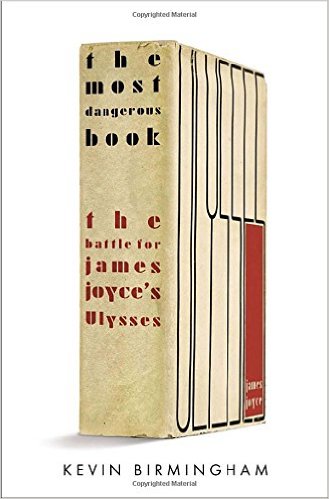
A Portrait of "Ulysses" as a Young Novel

Book Review: The Most Dangerous Book: The Battle for James Joyce's Ulysses by Kevin Birmingham

In all of my reading experience (and I am talking about literally thousands of books under my belt), somehow I have managed to miss out on the unique experience that is James Joyce's Ulysses.

Now, having read Kevin Birmingham's The Most Dangerous Book, I still may not have the urge to dive into Joyce's stream of consciousness, but I certainly have an understanding of what makes it one of the most important books of modern (and modernist) literature.

Discussions of literature often treat the work as somehow separate from the context in which it was written, and often as separate from the author himself. Birmingham treats us to more than just a critical analysis of Ulysses, of which scores have already been written. Dangerous Book is equal parts history, biography, and literary criticism; it places James Joyce and his work in the context of contemporary events, the work of other authors, and Joyce's personal struggles. Rather than looking at Ulysses as a thing apart, he takes us between the covers of the often troubled mind of Joyce, and the often troubled times he lived in.

As Birmingham show us, Ulysses becomes more than just the prototypical modernist novel, more than just a controversial and banned book. In no small way, Ulysses is the story of James' own journey as an author; the journey of his crowning work from scattered notes to the printed page is no less an epic voyage.

The interplay of life and art that is revealed here is astounding in its complexity. Ulysses, that most dangerous book, scared censors not just for what it tells about the characters in the story, but for what it tells us about ourselves. Kevin Birmingham draws us a portrait of a man, his book, and the world around them, and shows us how they all fit together to bring Ulysses home.

Wednesday, November 12, 2014

Just Below the Surface

Book Review: Land of Love and Drowning by Tiphanie Yanique

" ... men who spend their lives on the water know that magic is real."

On the surface, Tiphanie Yanique's Land of Love and Drowning is a multigenerational tale of a family in the Virgin Islands in the early 20th century. As such, it is an interesting enough novel, detailing the ways in which the characters interact -- their lives and loves and travails. The reader gets a taste of the island culture: the flavor of the language, the beauty of the landscape, the aroma of indigenous cooking.

But when the reader dives deeper, into the warm depths of Love and Drowning, he finds an entire world hidden below the relative calm above. Strong currents of racism, roiling storms of war, schools of segregation, and whirlpools of adultery lie in wait.

The transfer of the Virgin Islands from Danish rule to American guardianship turns out to be simply the exchange from one type of colonialism to another. The Americanization of the Virgin Islands brings the foreign concept of private property ownership, and the fencing off of the beaches. There was a gain in material comforts, but it was in exchange for a loss of liberty.

With the influx of American cars and plumbing and electricity came American racism and segregation. The fences on the beaches extend into daily life, with restrictions based on color lines. Miscegenation was frowned on, the historical mixing of African and European and Asian and Carib. Islanders who served in the armed forces returned from the mainland disillusioned; they had expected to be accepted by their new American compatriots, only to find doors closed to them.

Yanique skillfully interweaves the personal stories with the larger events to create a whole cloth - we see history from the personal perspective of the characters, and each is given equal weight. Placed against the magical, mystical background of the islands, Land of Love and Drowning gives us the Virgin Islands as microcosm; where Jim Crow and Hollywood intersect with the ebb and flow of the Caribbean and the bleached bones of a shipwreck, lying just below the surface.

Saturday, October 18, 2014

"There are no cats in America"

Book Review: A Backpack, a Bear, and Eight Crates of Vodka by Lev Golinkin

In the animated movie, An American Tail, the simple immigrant mice have an idealistic view of the United States, including the belief that in America "there are no cats". Needless to say, they are shortly relieved of their naivete, and nearly of their lives as well.

In A Backpack, a Bear, and Eight Crates of Vodka, Lev Golinkin presents us with a deceptively simple story - his story - and we follow this childhood memoir down its seemingly predictable path. And then, like a matryoshka doll, we find that there is another story tucked inside it; and inside that one, another -- and another.

"The anti-Semites didn't know -- they hated because they had been programmed to hate, and they obeyed because they had to obey to survive. No one knew, no one understood, and, as the old saying goes, one will always fear what one doesn't understand."

Inside Golinkin's childhood memories nestle the dark tale of anti-Semitism, the story of the dissolution of the Soviet Union, and the ongoing history of immigrants to America. Inside those are the personal stories of the Ukrainian people, the struggle of Jews seeking escape to the West, and the organizations and individuals trying to aid them. And deep inside it all, the story of Lev Golinkin and his family.

As I dove farther down into the nested stories inside Golinkin's Backpack, I began to reflect on how this plays out in America today. Immigration has become a hot button issue - but then it always has been. It was no different in decades past when the immigrants were Irish, or Italian, or German. Those who had already managed to secure the blessings of liberty were all too eager to quench the lamp, close the golden door, and leave the masses huddled outside.

"Every immigrant expects something from America. People don't scale fences, trudge through deserts, abandon careers, friends, loved ones, the graves of their parents, risk their lives without hope of something waiting for them on U.S. shores."

My grandmother emigrated from Russia at the turn of the 20th century. Her family was German, among many who had been invited to settle in the Volga Valley; but the political situation had changed, dangerously. Her parents put their two daughters, barely teenagers, on a ship to the United States. For them, America represented hope, and freedom from fear.

A Backpack and a Bear is not an essay supporting immigration. It is just the story of a Jewish boy in the Ukraine who held that hope. In the process it becomes the story of all those who have ever made that journey to stand in the light.

Wednesday, September 3, 2014

A Collection of Pieces and Parts

Book Review: Problems with People by David Guterson

I love short stories. There ... I said it.

It started with Steinbeck, but branched out into Hemingway, Kipling, and Edgar Allan Poe; then on to Agatha Christie, Dorothy Sayers - I was hooked. Detective stories, science fiction, horror ... pick a genre. They are short, sharp, succinct; something that you can read in a sitting but that can stay with you for a lifetime ("The Tell-Tale Heart", "The Snows of Kilimanjaro").

David Guterson is a skillful writer; I especially enjoy his crafting of dialog. There is no shortage of excellent writing in the ten stories that comprise Problems with People. Yet somehow, the great writing does not seem to jell into great stories. At times I felt as if I was reading a character sketch, or a chapter randomly lifted from another book. I appreciate that the short story puts constraints on an author in terms of character development and plotting, however "short" should not mean fragmentary - there still needs to be a story.

At times, especially in the stories "Shadow" and "Hush", Guterson is almost there. I did not have that same feeling with those as I did with the remaining stories - that this was a longer work with some pieces left out, like a badly edited newspaper story. Guterson's use of the language approaches poetry at times, and can be a joy to read, the words like fine wine on the tongue. The pieces within the stories are very well done, sadly the parts don't come together as a whole.